Case Study: Leaving Odoo and Moving an Entire UAE Van Sales Fleet in 20 Days
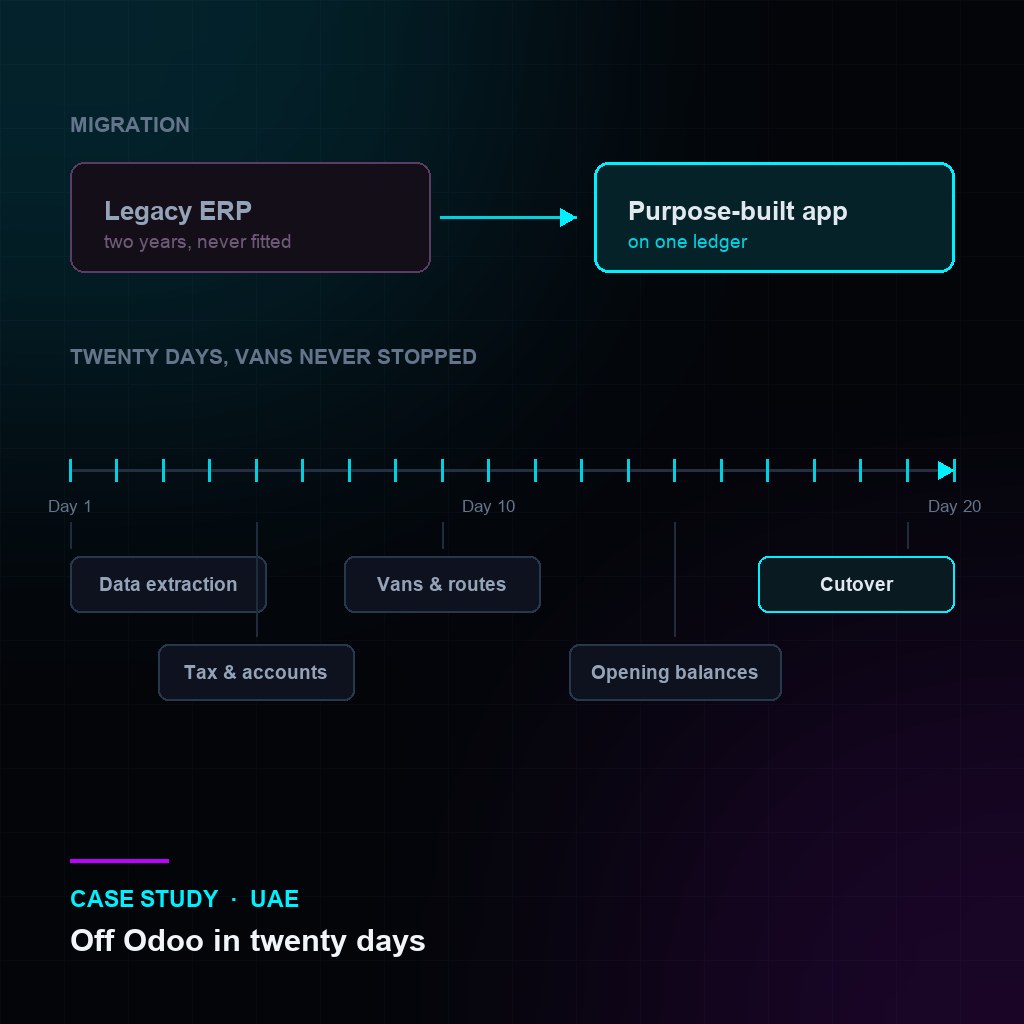
At a glance: A UAE distributor had run its van sales operation on Odoo for two years without ever being satisfied with it. We migrated the entire fleet onto our own Sellbee van sales application — every van, every route, every open balance — and had the whole operation running on the new system within 20 days.
Van sales is unusual among distribution models because the system of record is not in the office. It is in a vehicle, in the hands of a salesman who is loading stock at 6am, invoicing at the customer's counter, collecting cash across a dozen stops and settling at the end of the day. Generic ERP handles this badly, not because the accounting is complicated, but because the assumptions are wrong.
Standard ERP assumes a warehouse, a delivery note and an invoice raised from a desk. Van sales needs a moving warehouse, an invoice created at the point of sale from stock that is physically present, and a cash position per salesman that has to reconcile every single evening. When the software does not model that, the gap gets filled by paper and WhatsApp — and the books end up being reconstructed days later.
Two years of not-quite-working
This distributor had been live on Odoo for roughly two years. The system was not broken in any dramatic sense — invoices came out, the ledger balanced eventually — but it had never fitted the way the business actually operated, and after two years of workarounds the team had stopped expecting it to.
That pattern is worth naming, because it is far more common than outright failure. A system that is 70% right does not trigger a crisis. It triggers a slow accumulation of manual steps, side spreadsheets and tribal knowledge, until the cost of running the business on it is invisible but substantial. Nobody can point to the day it went wrong, because there wasn't one.
The decision point was not a failure. It was the realisation that another year of the same would cost more than replacing it.
Why a purpose-built van sales app, not another configuration
The obvious move would have been to reconfigure what was already there. We did not recommend it, for a specific reason: the mismatch was structural, not cosmetic. Van sales needs a handful of things that general-purpose ERP treats as edge cases:
- The van as a real stock location. Loading is a stock movement, not a note in a field. Van balance must be knowable at any moment, and reconcilable at end of day.
- Invoicing at the counter, from van stock. The salesman cannot sell what is not on the vehicle, and the document has to be created where the sale happens.
- A cash position per salesman. Collections, credit sales and returns all move one person's balance. Settlement is a daily event with a number that either reconciles or does not.
- Working without a reliable connection. Trade counters, basements and industrial areas are not where mobile data is at its best.
- Returns and exchanges at the point of sale, including damaged and expired goods, without a round trip to the office.
Sellbee is our own application built around exactly this pattern, sitting on top of ERPNext so that the accounting, stock and customer master stay in one ledger rather than in a sales tool bolted to the side. That distinction matters: the salesman gets an app designed for the vehicle, and the finance team gets a single set of books.
What 20 days actually looked like
Twenty days is a short window for a live distribution business, and it only works when the sequence is right. The constraint that shapes everything is that the vans cannot stop. There is no weekend to cut over in; stock keeps moving and customers keep ordering.
| Stage | What it covered |
|---|---|
| Data extraction | Items, customers, price lists, outstanding balances and van-held stock pulled out of the existing system and cleaned |
| Chart of accounts and tax | UAE VAT at 5% configured correctly from day one, with tax treatment matching how the business actually invoices |
| Van and route setup | Each vehicle as its own stock location, each salesman with a cash account, routes and customer assignments |
| Opening balances | Customer receivables and physical van stock counted and entered as openings — the step that decides whether day one reconciles |
| Salesman training | On the vehicle, in the field, in the language the team works in — not in a classroom |
| Cutover | All vans moved across, with close support through the first settlement cycles |
The part that consumes the time is never the software. It is opening stock and opening receivables. A van sales migration lives or dies on whether the physical stock on each vehicle on cutover morning matches what the system says it has — because if it does not, the first day's settlement will not reconcile, and the team will conclude the new system is wrong.
The lesson we apply to every van sales cutover: count the vans physically, on the morning of go-live, with the salesman present and signing. Every migration that has gone smoothly did this. Every one that got painful tried to trust the outgoing system's stock figures.
What changed
The most immediate difference in an operation like this is not a headline efficiency number. It is that the daily settlement stops being an argument. Each salesman's stock and cash position is derived from documents the salesman created himself, at the point of sale, so the end-of-day figure is something to confirm rather than reconstruct.
The second change is visibility during the day rather than after it. Van stock, invoices raised and collections are in the system as they happen, so the office is not waiting for the vehicles to return to know where the business stands.
And because the app sits on ERPNext rather than beside it, VAT reporting, customer statements and stock valuation come from the same ledger as the field activity — which removes the reconciliation layer that existed purely because two systems disagreed.
If you are in the same position
A few honest observations for distributors weighing up whether to move:
- Two years of workarounds is data, not bad luck. If a system has not fitted after two years of effort, more configuration is unlikely to close the gap. The question is whether the mismatch is structural.
- Judge a migration by opening balances, not by feature lists. Ask any prospective partner precisely how they will handle van stock and customer receivables at cutover. A vague answer is the warning sign.
- Train on the vehicle. Van sales teams do not learn software in meeting rooms, and adoption is the entire risk in this model.
- Keep one ledger. A field app that does not write to the same books simply relocates the reconciliation problem.
- Speed comes from scope discipline. Twenty days is achievable because the scope was the van sales operation done properly — not every idea the business has ever had.
Van sales rewards systems that match the physical reality of the job. When the software mirrors what is actually happening on the vehicle, the paperwork stops being a second job and the numbers stop being a monthly investigation.